WHAT DOES PAID MEMBERSHIP MEAN? COMPLETE GUIDE FOR 2026
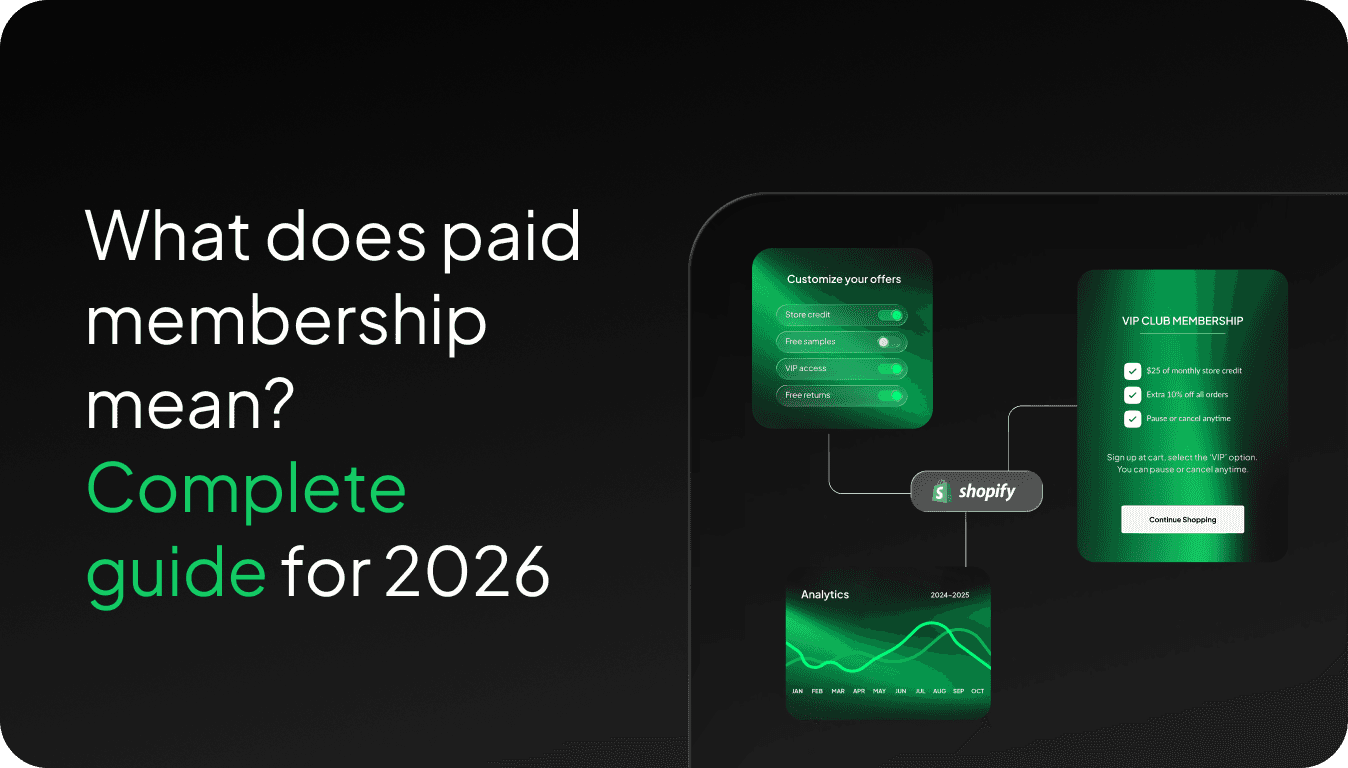
Everything you need to know about paid membership models, how they work, and why brands are switching from traditional subscriptions.
What Does Paid Membership Mean?
Paid membership means customers pay a recurring fee to access exclusive benefits, store credit, or premium services from a brand. Unlike traditional subscriptions that auto-ship products, paid membership gives customers value upfront, usually in the form of store credit equal to or greater than what they pay, plus additional perks like discounts, early access, and free shipping.
The key difference: customers aren’t buying products on autopilot. They’re buying access to better terms with your brand.
How Paid Membership Actually Works
Most people confuse paid membership with product subscriptions. They’re completely different models.
Product subscription: Pay monthly, get a product shipped automatically. Think Dollar Shave Club or Birchbox.
Paid membership: Pay monthly, get immediate store credit plus perks. Spend that credit whenever you want on whatever you want. Think Costco, but for e-commerce.
Here’s a real example from Tres Colori, a jewelry brand: customers pay $25 monthly for “Tres VIP” membership. They immediately receive $25 in store credit plus 10% off everything. The credit feels like money they already own, so they come back to spend it. Result: 48% of total revenue now comes from members.
The psychology is powerful. When someone has $25 sitting in their account, it doesn’t feel like a future purchase. It feels like money waiting to be spent.
Why Brands Are Switching to Paid Membership
Traditional customer retention strategies aren’t working anymore. Points programs have a 15% average redemption rate. Most customers earn points and forget about them.
Paid membership flips this dynamic. Instead of rewarding after the purchase, you give value upfront. The commitment happens first.
Pair Eyewear proves this works even in unlikely categories. Eyewear doesn’t fit traditional subscriptions, as people don’t want glasses shipped monthly. But their “Pair+” membership delivers 157% higher LTV for members versus non-members. They A/B tested against their top 20% best shoppers. Members won by 43%.
The model works because it solves a fundamental problem: most brands only connect with customers at the moment of purchase. Paid membership creates an ongoing relationship.
What Makes Paid Membership Different from Loyalty Programs
Loyalty programs reward past behavior. Paid membership creates future behavior.
Points accumulate slowly. Store credit arrives instantly.
Here’s the difference in action: Riversol, a dermatologist-developed skincare brand, was stuck with customers who bought the same single product repeatedly. Their loyalty program wasn’t driving discovery.
They launched “Riversol+” membership at $39 monthly. Members get $39 store credit plus 10% off plus early access. Result: 62% increase in customer lifetime value and actual product discovery across their full range.
The key insight: when customers have credit waiting, they explore. When they have points accumulating, they often don’t.
Real Performance Data from Paid Membership Programs
The numbers tell the story. Across brands using paid membership models, here’s what happens:
Average opt-in rate: 32% of shoppers join at first visit Store credit redemption: 70% versus 15% for loyalty points Lifetime value increase: +115% after 14 months Revenue from members: 25-50% of total brand revenue
Dossier, a fragrance brand, sees 45% of shoppers opt into “Dossier+” membership at checkout. Nearly half of all customers choose to pay for membership immediately.
This isn’t theoretical. It’s happening across jewelry, eyewear, skincare, and fragrance, categories where traditional subscriptions make no sense.
How to Structure a Paid Membership Program
The most effective structure follows three principles:
Credit equals or exceeds fee: If you charge $30 monthly, give at least $30 in store credit. The math needs to feel obviously good for the customer.
Stack additional perks: 10% off everything, free shipping, early access, member-only sales. The credit is the foundation. Perks are the multiplier.
Make spending frictionless: Credit should apply automatically. No codes, no complicated redemption. The experience needs to feel seamless.
Madam Glam built their “VIP Club” this way and generated $2.8M in membership revenue after launching. The key was making the value proposition impossible to ignore and the experience effortless.
Common Mistakes to Avoid
Charging more than you give in credit: If the math doesn’t work in the customer’s favor immediately, adoption will be low.
Making redemption complicated: Complex point systems kill engagement. Store credit is simple. Points with tiers and multipliers confuse people.
Focusing only on discounts: Discounts train customers to wait for sales. Store credit trains them to come back and spend.
Treating it like a subscription: Don’t auto-ship products unless customers explicitly want that. Membership is about access, not automated purchases.
The biggest mistake is thinking paid membership competes with loyalty programs. They work better together. Casual customers earn points. Best customers pay for premium benefits.
The Future of Paid Membership in E-commerce
We’re seeing a shift from transaction-based relationships to membership-based relationships. Customers want to belong, not just buy.
The brands winning in 2026 understand this. They’re building communities around their products. Paid membership is the infrastructure that makes this possible.
Victoria’s Secret’s acquisition of Adore Me for $400M in 2023 proved this. Adore Me was 5% of VS revenue but drove 30% of the deal value. The membership model was the key differentiator.
Ironically, VS shut down the Adore Me membership in February 2025 and replaced it with a standard loyalty program. This shows how hard it is to operate membership successfully without the right focus and tools.
That’s exactly why platforms like Subscribfy exist, to give brands both the technology and strategic guidance to run successful membership programs on their own terms. The combination of store credit automation, member analytics, and proven playbooks from brands like Pair Eyewear and Riversol makes the difference between a membership program that thrives and one that gets shut down.
The question isn’t whether paid membership works. The data is clear. The question is whether you’re ready to shift from selling products to building relationships.

Book a meeting with our sales team now!
Create predictable revenue from the customers you already have.