What Are the Most Effective Pricing Strategies for E-Commerce in 2026?
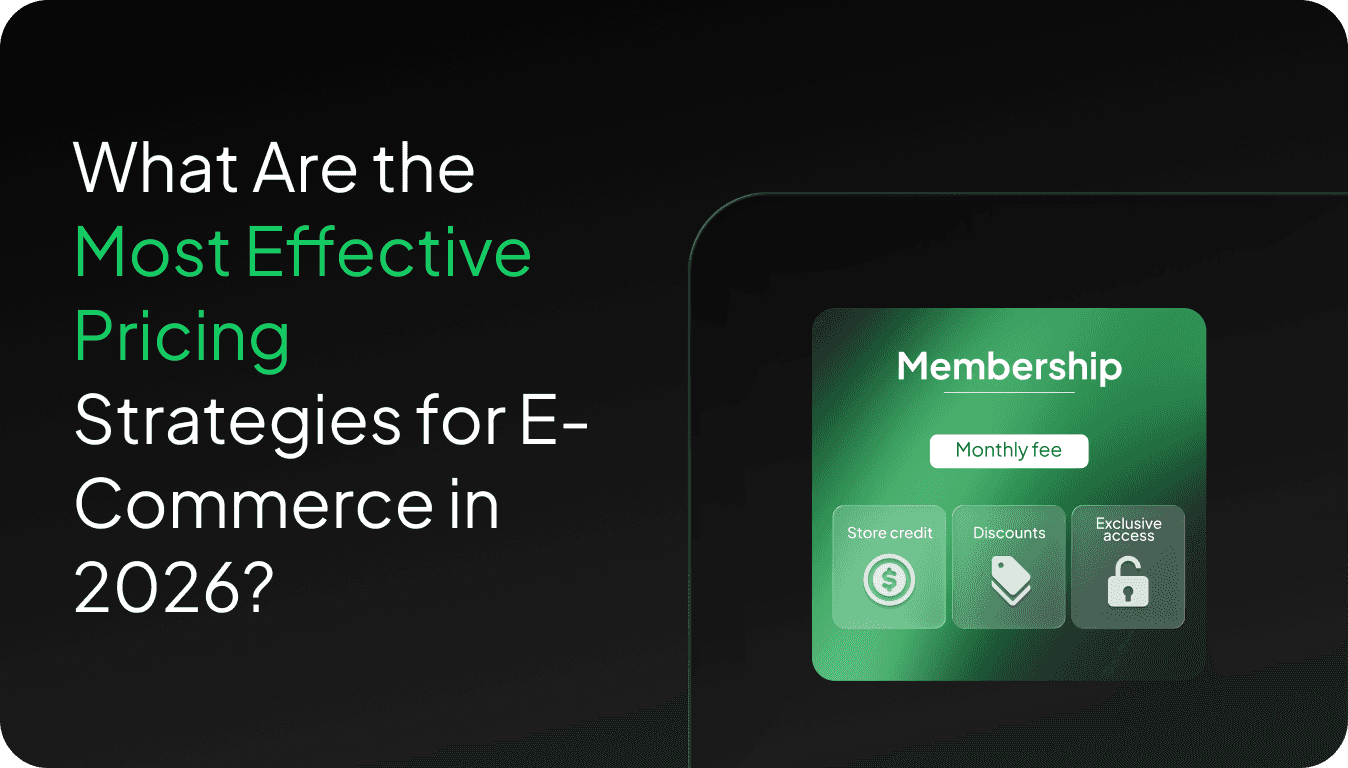
Seven approaches that actually move the needle on revenue, margin, and customer retention, with real data from DTC brands.
Pricing Is Strategy, Not Math
Most e-commerce brands treat pricing like an accounting problem. Cost plus margin equals price. Done.
That’s wrong.
Pricing is the single most direct signal you send to your customers about the value of what you sell. It shapes who buys, how often they come back, and whether your business compounds over time or stays flat. Even small improvements in price realization tend to deliver more profit impact than equivalent improvements in volume or cost reduction.
Here are seven strategies worth implementing, not in theory, but in practice.
1. Value-Based Pricing: Charge What It’s Worth, Not What It Costs
Value-based pricing means setting prices based on perceived customer value, not your cost structure. If your product solves a painful problem or delivers clear emotional or functional ROI, you price toward that outcome.
Dossier, the fragrance brand, doesn’t compete on cheap perfume. They compete on the value of fine fragrance without designer markup. That framing justifies their pricing and makes customers feel smart, not cheap. The result: 48% of shoppers opt into their Dossier+ membership at checkout, a clear sign customers see the value well beyond the base price.
If you’re pricing based only on COGS, you’re leaving money on the table every day.
2. Tiered Pricing: Give Customers a Ladder to Climb
Tiered pricing creates multiple product or service levels at different price points. Entry-level gets customers in the door. Higher tiers extract value from customers willing to pay more.
This isn’t just for SaaS. DTC brands can do this with product bundles, membership levels, or kit sizes. The key is that each tier must have a clear reason to upgrade, not just “more product,” but a meaningfully different value proposition.
Shopify’s research on repeat customers confirms what DTC operators already know: customers who buy more than once are worth dramatically more over their lifetime. Tiered pricing accelerates that behavior.
3. Psychological Pricing: The Brain Is Not a Spreadsheet
Charm pricing ($49 instead of $50) works. So does anchoring. So does the decoy effect.
But the most powerful psychological pricing move in e-commerce right now is showing non-member price versus member price side by side on the product page. When a customer sees $68 crossed out and $52 highlighted for members, the discount feels earned and exclusive, not desperate.
Pair Eyewear does exactly this. The result: members deliver 216% higher LTV than non-members, and 38% of total revenue now comes from membership alone.
Perception of value is as powerful as the actual discount. Sometimes more.
4. Dynamic Pricing: Let the Data Drive the Number
Dynamic pricing means adjusting prices in real time based on demand, inventory, competition, or customer segment. Airlines do it. Hotels do it. E-commerce brands are increasingly doing it.
For DTC, this can be as simple as surge pricing during high-demand periods, markdown rules for slow-moving SKUs, or differentiated pricing for different customer segments. Members get one price. Everyone else pays more.
The technology to do this is increasingly accessible, and pricing personalization tends to outperform blanket discount strategies on both conversion and margin.
5. Bundle Pricing: Increase AOV Without Discounting Individual Items
Bundles let you sell more per transaction while protecting the perceived value of each individual product.
The mechanic: bundle three complementary products and price the bundle at a discount to buying them separately. The customer wins on perceived value. You win on average order value and reduced cart abandonment.
Riversol, the dermatologist-developed skincare brand, used a combination of membership credits and product bundling to drive product discovery across their full range. Before, customers were buying one SKU repeatedly. After launching their membership with a credit model, customers started exploring, resulting in a 66% increase in customer lifetime value.
Bundles don’t just drive revenue. They educate customers about your catalog.
6. Membership Pricing: The Most Underused Lever in E-Commerce
This one is underused, underestimated, and, when done well, the most powerful pricing strategy on this list.
Membership pricing means customers pay a recurring monthly fee in exchange for exclusive benefits: store credit, discounts, early access, free shipping. The fee creates commitment. The benefits create retention. The credit creates repeat purchase behavior.
The model works in categories where you’d least expect it. Tres Colori, a jewelry brand, launched a paid membership at $25/month. Members get $25 in store credit plus 10% off everything. Today, 50% of total revenue comes from members, and 82% of members come back to use their credit. In jewelry. A category with no natural replenishment cycle.
Madam Glam generated $2.8M in membership revenue after launching their VIP Club. Nailboo, Pair Eyewear, and Dossier all report members spending dramatically more per year than non-members.
The credit-first mechanic is the key insight here. Store credit doesn’t feel like a subscription. It feels like money the customer already owns. That changes behavior: research on retention economics consistently shows how much a customer’s sense of ownership over a relationship affects whether they stay.
Compare that to standard loyalty points: store credit sees redemption rates well above 50% on average, and often 80% or higher. Points programs average around 14%. The gap is not small.
7. Price Anchoring: The First Number Wins
Anchoring means presenting a higher reference price before your actual price so the actual price feels like a deal.
You see this with crossed-out retail prices, “compare at” labels, or presenting a premium option first in a tiered lineup. The brain evaluates prices relative to each other, not in absolute terms. Whatever number comes first in the customer’s experience becomes the benchmark everything else is measured against.
This is why showing non-member price versus member price works so well at checkout. The non-member price anchors the perception of value. The member price feels like a reward for making a smart decision.
Baymard Institute’s research on checkout behavior shows that perceived savings, not just actual savings, drive conversion. Anchoring is how you create that perception systematically.
The Pricing Strategy Most Brands Skip
Most brands implement one or two of these strategies in isolation. The brands winning on retention implement several of them in combination.
The most powerful combination: membership pricing layered on top of value-based pricing, with psychological anchoring on product pages. A member sees your products with member pricing highlighted, feels the perceived value, and has store credit sitting in their account waiting to be spent. That’s not a customer. That’s a recurring revenue line.
Brands using Subscribfy’s paid membership platform report 115% higher LTV at 12 months and checkout opt-in rates in the high-40s to 60%+ range. That’s what happens when pricing strategy and retention infrastructure work together.
If you want to model what this looks like for your own store, the Subscribfy ROI Simulator runs the numbers based on your actual traffic and AOV.
Pricing isn’t set-it-and-forget-it. It’s one of the most important ongoing decisions your business makes. Treat it that way.

Book a meeting with our sales team now!
Create predictable revenue from the customers you already have.