Loyalty Program App Free: What You Get vs. What You Need in 2026
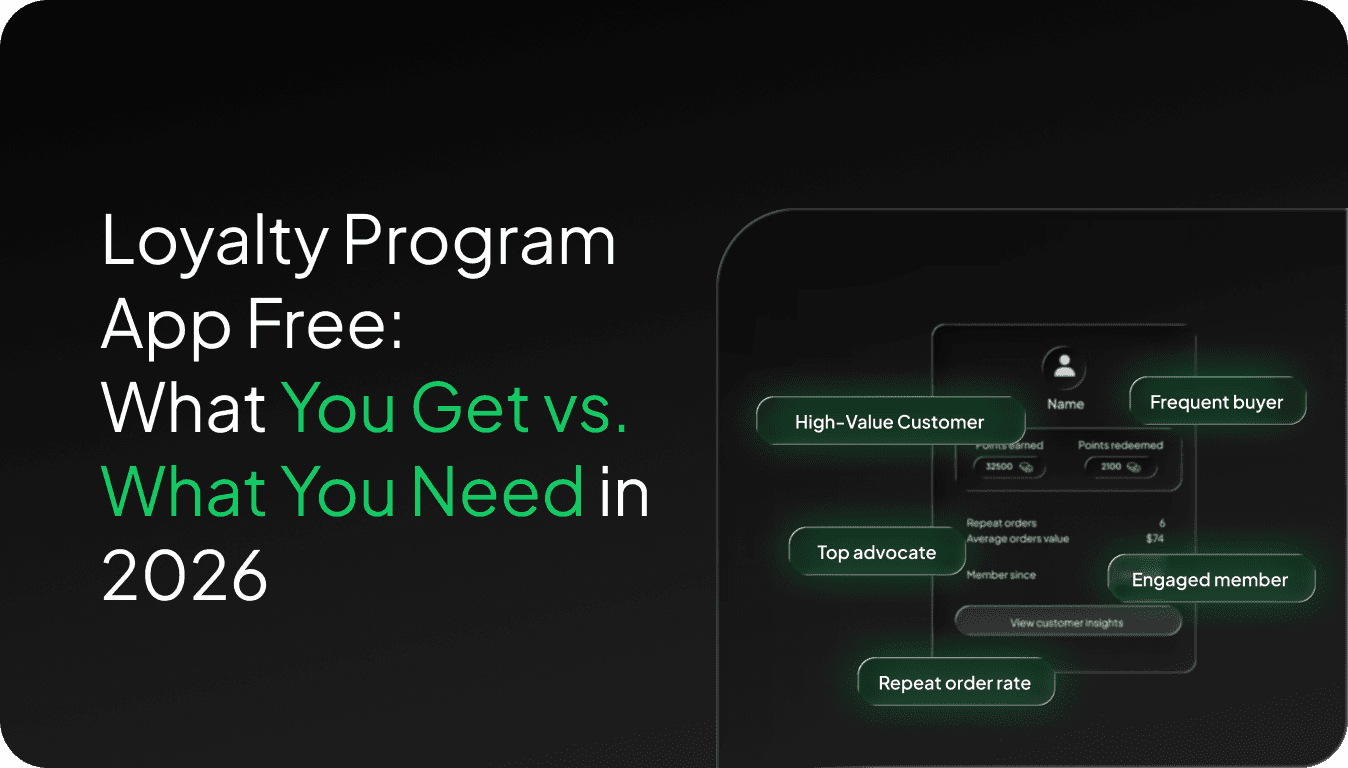
Free loyalty apps promise a lot. Here's what the free tier actually gives you, where it runs out, and what brands with real retention goals are building instead.
The Real Cost of “Free” Loyalty Apps
Free doesn’t mean no cost. It means the cost is hidden somewhere else.
Every major loyalty program app offers a free tier. Smile.io, Yotpo, Growave: they all have one. And for a brand doing under $10K/month with a handful of orders, a free tier might genuinely be enough to start.
But here’s what the free tier almost always cuts: advanced segmentation, email integrations, points expiry rules, VIP tiers, referral programs, custom branding, and, critically, any analytics beyond basic point counts.
You get the skeleton. Not the engine.
Shopify’s research on loyalty programs consistently shows that the brands driving meaningful repeat purchase rates aren’t running skeleton programs. They’re running systems with tight integration between rewards, email flows, and customer data.
What Free Loyalty Tiers Actually Include
Here’s what you typically get on a free plan across the major apps:
Basic points earning (purchases, account creation, sometimes birthdays)
A simple points redemption widget on your storefront
No email integration (or severely limited, like 100 emails/month)
No VIP tiers
No referral program (almost always a paid feature)
Basic branding (their logo, not yours)
Limited or no customer segmentation
That’s a starting point. Not a retention strategy.
The average loyalty points redemption rate across e-commerce is around 14%. Free programs with no email triggers, no expiry nudges, and no VIP incentives tend to land at the low end of that range, or below it.
Points your customers never redeem aren’t building loyalty. They’re just data sitting in a database.
When Free Is Enough (And When It Isn’t)
Free loyalty tiers are genuinely useful for three scenarios: early-stage brands testing whether their customer base responds to rewards at all, stores with low transaction volume that don’t yet justify a $99/month tool, and brands with a simple single-tier rewards model and no ambition to segment customers.
If you’re past any of those three stages, free is holding you back.
The moment you want to trigger a win-back email when a member’s points are about to expire, you need an integration with Klaviyo. That’s a paid feature. The moment you want to reward different customer tiers differently, you need VIP logic. Paid feature. The moment you want to track whether your loyalty program is actually increasing customer lifetime value, not just issuing points, you need real analytics. Paid feature.
This is the retention gap most brands hit between month three and month six of running a free loyalty program: they have a lot of members, no visibility into behavior, and no levers to pull.
The Problem That Points Programs Can’t Solve
Here’s the harder truth. Even a fully paid, enterprise-tier loyalty program has a structural ceiling.
Points reward the transaction after it happens. The customer buys, earns points, and then leaves. By the time the points are sitting in their account, you’ve already lost their attention. The redemption depends entirely on them remembering you exist, having enough points to redeem, and being motivated enough to come back.
That’s three things that have to go right. Usually, two of them don’t.
HBR research on retention economics shows that increasing customer retention rates by just 5% can increase profits by 25% to 95%. Points programs help at the margin. They rarely drive that kind of structural shift in retention.
What drives that shift is a different mechanic entirely: prepaid store credit.
What Happens When You Add a Paid Membership Model
Brands like Tres Colori, a jewelry brand, launched a paid membership where customers pay monthly and receive store credit equal to what they pay, plus a 10% discount on everything. The result: 82% of members come back to use their credit, compared to an industry average of about 14% for loyalty points.
That’s not a marginal improvement. It’s a different game.
Store credit feels like money the customer already owns. It creates a pull that points can’t replicate. Instead of hoping the customer remembers they have 240 points worth maybe $2.40, you’re reminding them they have $25 sitting in their account right now.
Riversol, a dermatologist-developed skincare brand, launched a $39/month membership with store credit and saw a 66% increase in customer lifetime value. Redemption rate: 58%. They launched in 30 days.
Jewelry. Skincare. Categories where traditional subscriptions make no sense. Membership still worked.
Free Loyalty vs. Paid Membership: The Numbers
Metric | Free Loyalty App | Paid Membership (Subscribfy avg) |
Avg redemption rate | ~14% | 50–80%+ |
LTV lift at 12 months | Minimal | +115% |
AOV vs non-members | Similar | +32% higher |
Churn protection | Low | High (prepaid commitment) |
Margin impact | Points cost margin | Store credit replaces discounting |
The margin point matters. Points programs typically get funded by discounting: you issue 5% back as points, that’s 5% off your margin on every order. Paid membership replaces discount dependency. Members pay you upfront. The store credit they receive gets spent at full price. Shopify’s research on average order value confirms that retention tools that create purchase intent before the session starts outperform discount-at-checkout mechanics.
Should You Use a Free Loyalty App at All?
Yes, but only as the foundation layer, not the ceiling.
A free or low-cost loyalty program makes sense as the base: it captures every customer, rewards every transaction, and creates a reason to engage for casual buyers who aren’t ready to commit.
The real strategy is what sits on top of it. Your top 20% of customers, the ones who buy repeatedly and drive disproportionate revenue, deserve more than points. They deserve a reason to pay to belong. A VIP membership tier with real store credit, real perks, and a real sense of exclusivity is what converts your best customers from loyal-ish to locked in.
A small share of customers typically generates the large majority of revenue for most e-commerce brands. Running a free loyalty app for that segment is leaving serious money on the table.
The Platform That Does Both
Subscribfy is the only Shopify platform that runs paid membership, loyalty, and subscriptions as a unified system, not three disconnected apps. Loyalty is included free for every membership client.
The combination is deliberate. Casual customers earn points and stay engaged. Top customers pay for premium membership benefits and drive the revenue that compounds. A customer who pays to belong AND accumulates points toward a reward is the hardest customer to lose you can build.
If you’re still on a free loyalty tier and wondering why your retention numbers aren’t moving, the answer usually isn’t a better free plan. It’s a different model.
Run the ROI simulator and see what membership would do to your numbers before you decide.

Book a meeting with our sales team now!
Create predictable revenue from the customers you already have.