Your Best Customers Are on Their Phones. Your Loyalty Program Isn't.
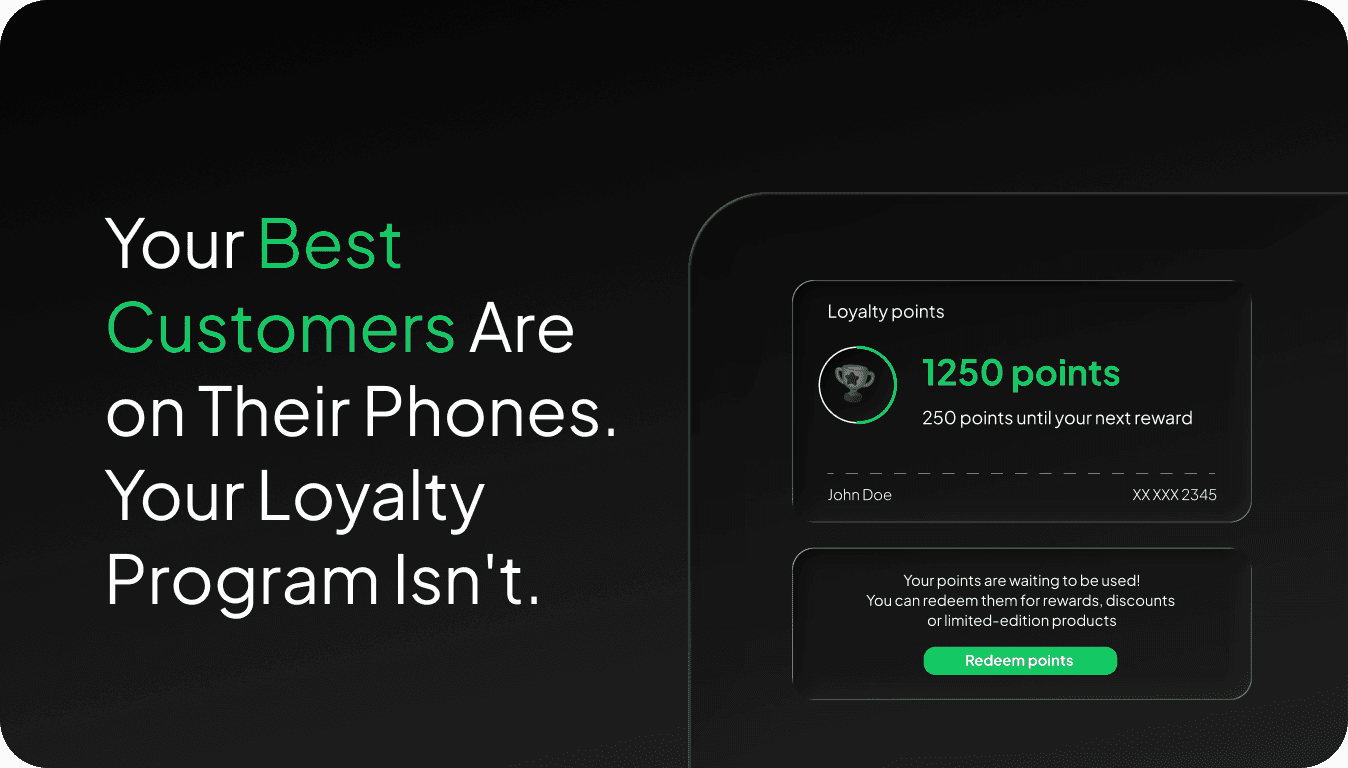
73% of ecommerce traffic is mobile. Your loyalty program lives in a browser tab your customer closed three weeks ago. Apple Wallet puts your brand next to her credit cards. That's a different conversation.
Your customer checks her phone 96 times a day. She opens her email app maybe twice. She opens Apple Wallet every time she pays for anything.
Your loyalty program lives in one of those channels. Guess which one.
The mobile attention problem
Mobile devices account for 73% of ecommerce traffic globally. Your customers are shopping on their phones, browsing on their phones, and paying with their phones. The phone is the primary touchpoint for virtually every brand interaction.
Yet most Shopify loyalty programs require the customer to open a browser, navigate to your website, log in, and check her balance. On mobile, that's four friction points. Most customers don't make it past the first one.
The result: your loyalty program is invisible for 99% of the customer's day. She doesn't know she has points. She doesn't know she has credit. She doesn't know you exist, because you're buried behind a login screen she can't be bothered to open.
Email tries to bridge this gap, but ecommerce email open rates average 15.50%. Push notifications from branded apps perform slightly better, but they require the customer to download your app first, and the average retention rate for shopping apps drops to 25% within 30 days of install.
There's a channel that requires no app download, no login, and no inbox competition. It's already on every iPhone and Android device. And it's the one place customers look multiple times every day.
Apple Wallet and Google Wallet: the overlooked channel
Apple Wallet (and Google Wallet) isn't new technology. It's been on iPhones since 2012. But most ecommerce brands treat it as a feature for boarding passes and event tickets, not a retention channel.
That's a mistake. Here's what a Wallet pass can do for an ecommerce membership:
Display the customer's current store credit balance in real time. Not "check your balance on our website." The balance is right there, on her phone, alongside her credit cards and transit pass.
Show her membership tier and status. "VIP Member" displayed permanently on a branded card in her wallet.
Send push notifications without competing with email. When new credit drops, the pass updates and sends a notification. No inbox. No spam folder. No 15% open rate ceiling. The notification comes from the Wallet app itself.
Update dynamically. The balance changes when she makes a purchase or receives new credit. The pass is always current.
This creates a passive brand presence that no other channel achieves. The customer doesn't need to take any action to see your brand. She just opens her wallet to pay for coffee, and there you are: "$15.00 available at [Your Brand]."
The behavioral impact of persistent visibility
The psychology here is straightforward but powerful.
Adobe's purchase probability research shows that purchase probability decays with time between interactions. The longer a customer goes without engaging with your brand, the less likely she is to return.
A Wallet pass resets this decay clock passively. Every time the customer sees her card (which happens multiple times daily in normal phone usage), it counts as a micro-interaction. She's reminded that she has money to spend. Her brand familiarity stays current. The probability decay never gets a chance to set in.
This is fundamentally different from email or ads, which are active interruptions the customer can (and does) ignore. The Wallet pass is ambient. It exists in a space the customer already uses for her own purposes. It's not competing for attention. It's just present.
Subscribfy merchants who enable Wallet Pass see measurably higher engagement rates among members who add the pass to their phone vs. those who don't. The credit is the same. The membership is the same. The difference is visibility.
Pull quote: "Your customer opens Apple Wallet every time she pays for anything. That's where your brand should be. Not buried behind a login screen."
Why branded apps fail where Wallet Pass succeeds
The obvious alternative is a branded mobile app. Many Shopify brands have explored this, and most have been burned by the economics.
Building a mobile app costs $50K to $200K+ depending on features. Maintaining it costs $2K to $10K/month. And the hardest part isn't building it. It's getting customers to download it.
App install campaigns run $2 to $5+ per install on Meta, and most ecommerce apps see 75% uninstall rates within 30 days. You're paying to acquire an app user who deletes the app before her next purchase.
Wallet Pass requires no download. No app store listing. No install campaign budget. The customer adds the pass with a single tap from her membership confirmation email or the post-checkout page. It takes two seconds. There's no app to maintain, no updates to push, no storage space on her phone to compete for.
The cost difference is orders of magnitude. A branded app might cost $100K+ in year one and reach 5% of your customer base. A Wallet Pass costs a fraction of that and can reach every member who opts in.
Wallet Pass + store credit: the compounding loop
The real power of Wallet Pass emerges when it's paired with store credit membership.
Here's the loop:
Customer joins a membership at checkout. She adds her membership card to Apple Wallet with a single tap.
Month one: $15 in store credit drops. Her Wallet pass updates to show "$15.00 available." She gets a push notification. She visits the store and makes a purchase using her credit. The pass updates to reflect her new balance.
Month two: new credit drops. The pass updates again. Another notification. Another visit. The credit-to-visit-to-purchase cycle repeats.
Each iteration reinforces the habit. The Wallet pass ensures the customer never forgets about her credit. The credit ensures she has a financial reason to return. The purchase ensures the behavioral habit deepens.
Without Wallet Pass, this loop depends on email (15% open rate) to remind the customer about her credit. With Wallet Pass, the reminder is ambient and persistent. The loop completes more reliably and more frequently.
Pair Eyewear's Pair+ membership (+157% LTV) and Dossier's Dossier+ program (45% opt-in) both leverage Wallet Pass as part of the member experience. The credit does the retention work. The Wallet pass ensures the credit is visible.
Implementation on Subscribfy
Subscribfy includes Wallet Pass as a built-in feature, not a separate app or add-on. When a customer joins a membership, she receives an option to add her membership card to Apple Wallet or Google Wallet directly from the confirmation screen.
The pass is branded with your logo, colors, and membership tier. It displays the store credit balance in real time. It sends push notifications when new credit drops. And it requires zero technical setup beyond enabling it in the Subscribfy dashboard.
Pricing: Wallet Pass is included in Subscribfy's membership plans at $149/month for 1,000 passes with $0.05 per additional pass. For a brand with 5,000 active members, that's pennies per member per month for a channel that outperforms email on engagement metrics.
Compare that to a branded app ($100K+ build, $5K/month maintenance, $3/install acquisition) and the ROI calculation is obvious.
Subscribfy was built by the team that scaled Adore Me to $300M/year before the $400M Victoria's Secret acquisition. Wallet Pass is one piece of the full retention stack: membership, store credit, subscriptions, loyalty, chargeback prevention, and mobile engagement, all in one platform.
Your customers are on their phones. Your loyalty program should be too.
Put your brand in their wallet → Book a demo

Book a meeting with our sales team now!
Create predictable revenue from the customers you already have.