Shopify Subscriptions in 2026: What Actually Works
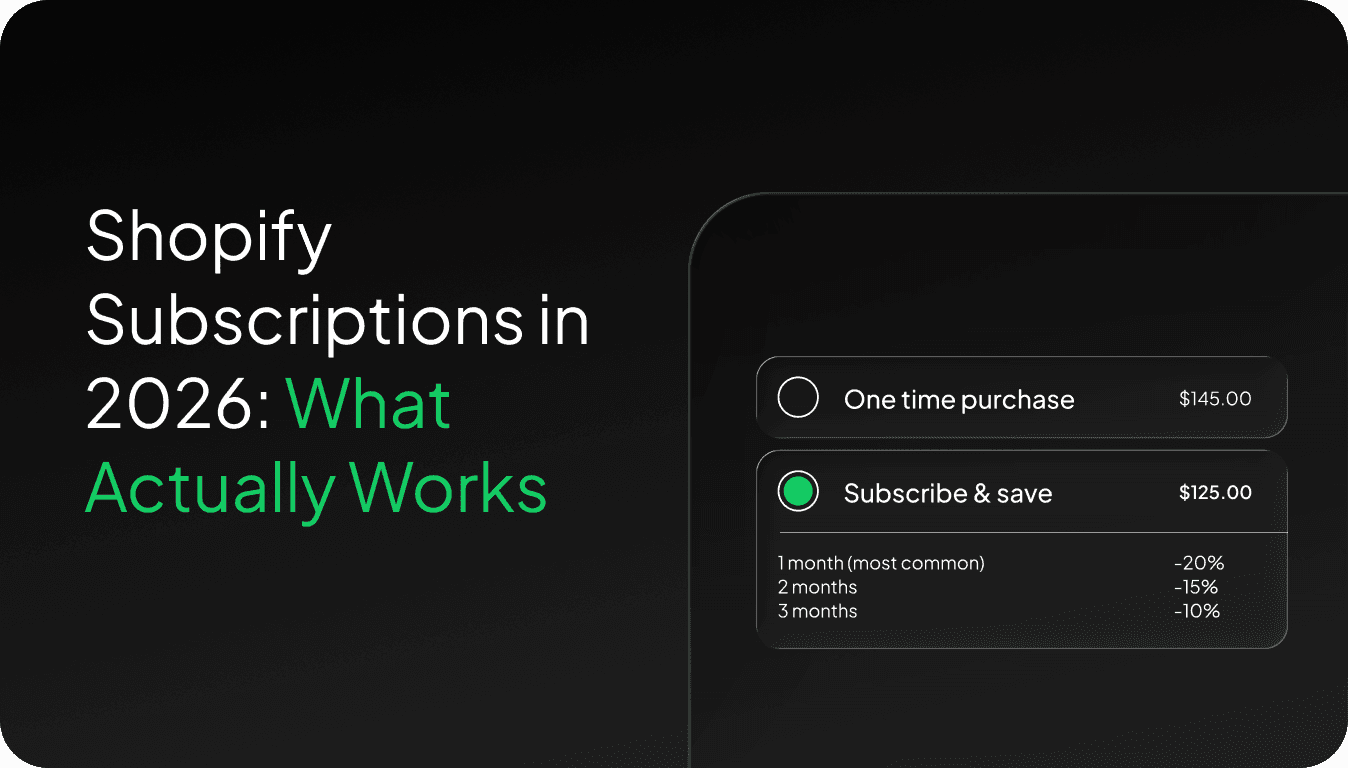
Most brands set up subscriptions and wonder why they churn. Here's what the data from 200+ retention programs actually shows.
Shopify Subscriptions: The Gap Between Setup and Results
You can launch a Shopify subscription in a weekend. The app installs in minutes. The checkout works. Orders go out automatically.
Then three months later, you look at your churn rate and wonder what went wrong.
That gap, between “subscriptions are live” and “subscriptions are working,” is where most brands get stuck. And it’s not a technical problem. It’s a strategic one.
This article breaks down how Shopify subscriptions actually perform in 2026, what the data says about why customers cancel, and what the brands with the strongest retention numbers are doing differently.
What “Shopify Subscriptions” Actually Covers
Shopify subscriptions is not one thing. It’s a category that includes at least three distinct models, each with different economics and different churn profiles.
Replenishment subscriptions auto-ship a product on a fixed schedule. Skincare, supplements, pet food, coffee. The customer sets it and forgets it, which is both the appeal and the problem. “Set and forget” becomes “cancel and forget” the moment the product sits in a cabinet.
Curated box subscriptions ship a selection of products each cycle. Higher perceived value, but operationally demanding. Customers cancel when the curation feels repetitive or the price-to-value ratio drifts.
Paid membership subscriptions charge a recurring fee in exchange for ongoing benefits: store credit, discounts, early access, free shipping. No physical shipment required. The customer pays to belong, not to receive a box.
Each model has different churn dynamics. Most guides to Shopify subscriptions treat them as interchangeable. They are not.
Why Shopify Subscription Churn Happens (And When)
Shopify’s own data on churn rate shows that most subscription cancellations happen within the first 90 days. Customers who survive 90 days have dramatically higher lifetime value.
The reasons for early churn fall into a short list:
The value wasn’t immediately obvious at signup
The product arrived too fast relative to actual consumption
There was no perceived sunk cost or ongoing benefit keeping them engaged
They signed up for a discount and left when it appeared
That last point matters. Discount-driven subscription enrollment is one of the most common mistakes. You attract price-sensitive customers, then keep them with a price that eats your margins. When you try to correct the price, they leave.
The brands with the lowest churn tend to be the ones where customers report feeling they’re getting exclusive access, not just a lower price. That framing difference, access vs. discount, is what separates retention programs that compound from ones that plateau.
The Replenishment Trap
Replenishment subscriptions solve a real problem: customers forget to reorder. Auto-ship solves the forgetting. But it creates a new problem.
When a product auto-ships, the customer never actively chooses to buy. They don’t experience the decision. They just look at a charge on their credit card. Over time, that passive relationship erodes engagement.
Active re-engagement, not passive fulfillment, is what drives long-term retention.
Riversol, a dermatologist-developed skincare brand, ran into exactly this pattern. Customers loved the products but only reordered the same single SKU. LTV was plateauing. Traditional subscriptions had low adoption. They needed something that drove product discovery, not just replenishment.
They launched a paid membership through Subscribfy at $39/month. Members received $39 in monthly store credit, 10% off all orders, early access to new launches, and free samples. The result: a 66% increase in LTV and a 58% store credit redemption rate, customers actively coming back to spend, not passively receiving shipments.
That’s the core difference. Replenishment is passive. A credit-first membership creates active intent.
What the Data Says About Subscription Models in 2026
Let’s get specific about the numbers that actually matter.
Average redemption rate for loyalty points: 14%. Most points programs generate engagement on paper but not at the register. Points accrue. Customers forget. Points expire.
Average redemption rate for membership store credit: well above 50%, and often 80% or higher in individual brand case studies. When a customer pays $25 and immediately receives $25 in store credit, that credit feels like money they already own. They come back to spend it. The psychology is completely different.
LTV lift at 12 months for paid membership customers: +115%. This is the number that changes how brands think about acquisition cost. If a member generates roughly double the lifetime value of a non-member, you can spend more to acquire them and still come out ahead.
Shopify’s breakdown of customer lifetime value frames LTV as the foundational metric for sustainable ecommerce. Subscriptions are only valuable insofar as they move that number.
The brands hitting those LTV numbers on Shopify are not running standard replenishment subscriptions. They are running membership programs where the customer pays to belong, receives real ongoing value, and stays because leaving means losing something.
Pair Eyewear: Proof That This Works in Non-Obvious Categories
One of the strongest arguments against paid membership is category fit. “My product doesn’t make sense as a subscription.”
Pair Eyewear sells frames and top frames. Customers don’t need new glasses every month. Traditional auto-ship subscriptions make no sense for them.
They launched “Pair+” anyway, a paid membership built around store credit and exclusive perks. No recurring shipment. Just monthly credit and access. The results were hard to argue with: 216% higher LTV for members versus non-members, 38% of total revenue now coming from membership, and a 52% store credit redemption rate.
They A/B tested members against their top 20% of non-member shoppers. Members won by 43%.
If membership works in eyewear, it works in your category.
The Technical Side: What to Look For in a Shopify Subscription App
From a pure technical standpoint, any Shopify subscription app should meet a short list of requirements before you consider it.
Native checkout. No redirects. No external checkout pages. Every redirect adds friction and drops conversion. Baymard Institute’s cart abandonment research consistently shows that checkout friction is a primary cause of abandonment.
Shopify-native billing. Subscriptions managed through Shopify’s own subscription API are more stable and compliant than third-party billing workarounds.
Klaviyo integration. Failed payment flows, churn prevention sequences, and reactivation campaigns require real-time event data in your email platform. An integration that syncs membership events (created, cancelled, paused, reactivated, successful charge, failed charge, credit expiry, gift card) gives you the raw material for serious retention work. Triggered, event-based flows consistently outperform broadcast emails.
Transparent pricing. Some platforms take a percentage of your GMV in addition to per-transaction fees. On a $1M subscriptions business, that difference is tens of thousands of dollars. Subscribfy’s pricing runs 0.49% plus 19 cents per transaction on product subscriptions, and 1.25%–1.49% plus 19–25 cents per transaction on memberships depending on plan, with no additional cut of total GMV.
The Question Worth Asking
If your Shopify subscriptions are live but not compounding, if churn is high, LTV is flat, and the growth isn’t showing up in the numbers, the question isn’t how to tweak the offer.
The question is whether the model itself is right for what you’re trying to build.
Replenishment solves forgetting. Membership solves belonging. Those are different problems with different solutions.
Run the numbers for your brand before deciding which model you’re building.

Book a meeting with our sales team now!
Create predictable revenue from the customers you already have.