Shopify Membership Program: Why Generic Tools Fail at Scale
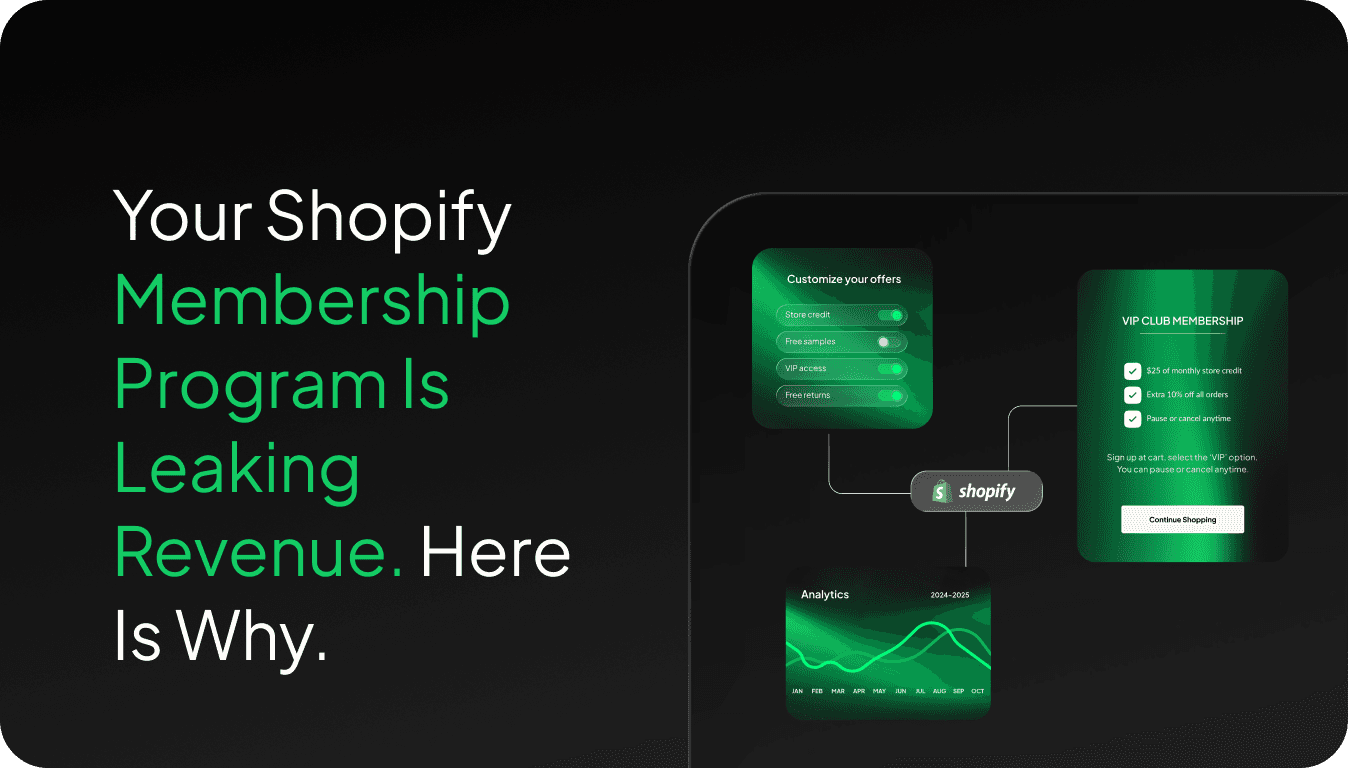
Why patched-together tools create invisible churn and how unified infrastructure fixes it
Your Shopify Membership Program Is Leaking Revenue. Here Is Why.
You built a shopify membership program. Customers are joining. Fees are coming in. On the surface, it works.
Then month seven arrives. Adoption has plateaued. A cohort of early members is quietly churning. Store credit is sitting unspent. And your team is manually cross-referencing spreadsheets to figure out who is at risk.
This is not a product problem. It is an infrastructure problem.
Most Shopify brands underestimate what membership management actually requires once a program passes a few hundred active members. The mechanics that work at launch break at scale. And by the time you notice the leakage, it has already been compounding for months.
Why Membership Revenue Is Harder to Protect Than It Looks
Membership fees create the illusion of predictability. The money arrives on schedule. The numbers look clean.
But there is a second layer most operators miss: the behavioral layer.
A member who joins and never redeems store credit is not loyal. They are passive. Passive members cancel. They do not complain first. They do not send a ticket. One day they are gone, and your MRR drops without warning.
This is the core challenge. Involuntary churn from failed payments is visible and fixable. Passive churn from disengagement is invisible until it is already a trend.
A generic Shopify setup does not distinguish between the two. It processes payments. It does not tell you that a member has not opened their portal in 45 days, that their store credit balance has been untouched for three months, or that their order frequency dropped after month two.
Without that signal, you cannot intervene. Without intervention, the cohort decays.
What Breaks When You Patch It Together
The standard approach for a growing DTC brand looks like this: Recharge or Skio for subscriptions, a points app for loyalty, a membership built on a workaround, and email flows stitched together manually.
Each tool does its job in isolation. None of them talk to each other at the data level.
The result is fragmentation that costs real money:
A member who is also a loyalty participant cannot see their combined value in one place. Your CX team is answering questions about points in one portal and membership credits in another. Your marketing team cannot build a segment of “high-LTV members with low recent engagement” because that data does not exist in a single system.
Patchwork retention tech is not a neutral choice. Every integration gap is a place where customer behavior becomes invisible. And as McKinsey’s research on personalization makes clear, brands that cannot act on individual customer data leave significant revenue on the table. Invisible behavior cannot be acted on.
What Members Actually Need to Stay
Retention is not a communication problem. It is a value-recognition problem.
A member stays when they consistently feel the program is working for them. That requires two things: they need to use their perks, and they need to see the perks as meaningful.
Store credit is the most effective membership perk in DTC because it drives purchase behavior directly. But store credit only works if the member knows it exists, knows what they have, and feels a reason to spend it.
A well-timed push notification through a wallet pass reminding a member that they have $39 in credit before a seasonal moment is worth more than five email campaigns. It meets the member where they are, with specific information about their account, at the right time.
This is the kind of execution that generic tooling cannot produce. It requires the membership system, the credit balance, and the communication layer to share data in real time.
The Proof Is in the Cohort
Brands that run unified membership infrastructure consistently see the same pattern across cohorts.
Members spend at least 100% more than non-members after 12 months. The returning customer rate is 59% higher for members. First-order AOV is 18% higher for members than for non-members. And membership fees alone account for 32% of total monthly income after 14 months.
These numbers do not come from better discounting. They come from behavioral consistency. Members who are actively engaged with a program order more frequently and spend more per order because the program makes returning feel natural and rewarding.
This matters more than ever as customer acquisition costs continue to rise. Protecting and expanding the revenue you already have is no longer optional. The brand that built Subscribfy learned this across millions of transactions while scaling Adore Me to $300 million in annual revenue before its acquisition by Victoria’s Secret. That institutional knowledge is not theoretical. It is the reason Subscribfy works the way it does.
What a Unified System Changes
Subscribfy runs paid memberships, product subscriptions, loyalty programs, wallet passes, and chargeback prevention in one connected system on Shopify.
The practical impact is not just operational efficiency. It is visibility.
When membership data, loyalty behavior, purchase frequency, and credit redemption are all in one system, the platform can surface what matters: who is at risk, who has unspent credit, who has not ordered in 60 days despite holding an active membership. That is the signal that makes retention proactive instead of reactive.
The Real Cost of Getting the Infrastructure Wrong
A shopify membership program built on patched tools will produce fragmented data, invisible churn, and a team that spends more time managing integrations than improving the program.
The brands that will outperform over the next three years are not the ones with the most traffic. They are the ones that convert acquisition into a durable revenue base, and then protect that base with infrastructure that can see what is happening at the member level.
Retention compounds. As Harvard Business Review has documented, acquiring a new customer costs five to 25 times more than retaining an existing one. A member retained into month seven generates more LTV than a new member acquired to replace them. The math is not complicated. The execution is where most brands fall short.
The right infrastructure does not guarantee retention. But it makes the difference between knowing you have a problem and finding out six months too late.
If you are ready to see what a unified membership program can do for your brand, Subscribfy launches programs in weeks, not months.

Book a meeting with our sales team now!
Create predictable revenue from the customers you already have.