California Automatic Renewal Law and Membership Opt-In
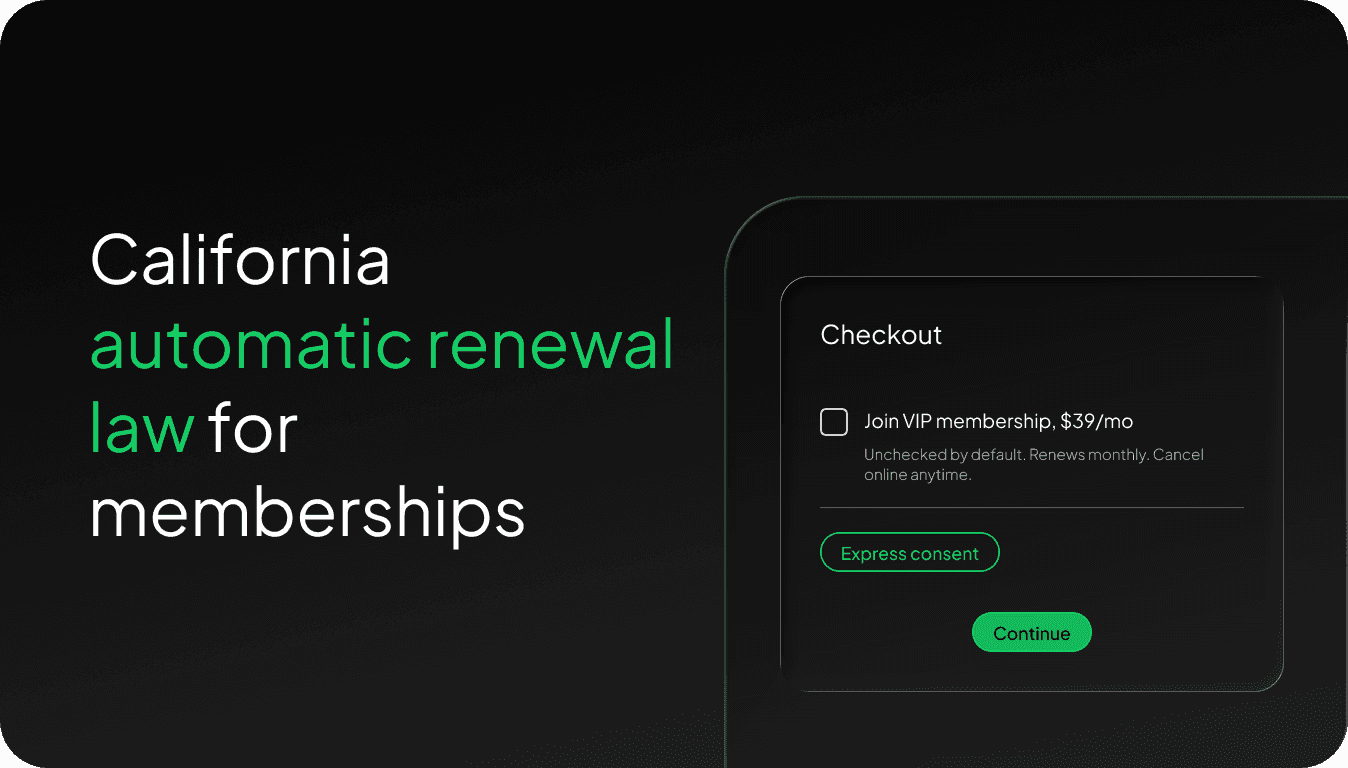
What California's amended automatic renewal law, ROSCA and the vacated FTC rule mean for membership checkboxes on Shopify in 2026.
Every paid membership launch hits the same trade-off at checkout. Leave the membership box unchecked and a small share of shoppers opts in. Pre-check it and opt-in jumps. The growth team wants the second number. Legal wants to know whether the second number is even allowed.
The short answer for 2026: under California’s automatic renewal law and federal rules, a pre-checked membership opt-in is the riskiest way to sell an auto-renewing membership in the United States, and in California it may leave you with charges you cannot keep. The longer answer depends on how the checkout is built, what the customer sees, and where they live.
This article is general information, not legal advice. Take it to your counsel.
What does California’s automatic renewal law require for membership checkouts?
It is high risk. Federal law requires express informed consent for online negative-option offers, and California’s amended auto-renewal law requires express affirmative consent. Practitioners read that as an action the customer takes, such as ticking an unchecked box, not a box already ticked for them.
California’s automatic renewal law, Business and Professions Code section 17600 and following, was amended by AB 2863 with changes effective July 1, 2025. Fenwick’s summary highlights the shift from “affirmative consent” to “express affirmative consent,” a term the statute does not define, plus a duty to keep proof of each customer’s consent for three years or one year after the contract ends, whichever is longer.
Davis+Gilbert’s analysis is the most useful for a checkout designer: the law does not expressly require an unchecked box, but a regulator would likely treat an unchecked box as satisfying the standard, and companies should expect class action lawyers to argue that an unchecked box is in fact required.
What happened to the FTC click-to-cancel rule?
The Eighth Circuit vacated the FTC’s click-to-cancel rule in its entirety in July 2025. That does not remove federal risk. The FTC still enforces the Restore Online Shoppers’ Confidence Act, which already requires clear disclosure, express informed consent and a simple way to cancel.
Cooley’s note on the decision explains that the vacated rule would have required consent to the negative option separately from the rest of the transaction, through a checkbox or similar affirmative act. It also notes that the FTC has been highly active under ROSCA, and that California’s July 2025 amendments impose requirements similar to several provisions of the vacated rule.
In practice, the vacated federal rule described the standard many state laws are converging on.
What happens if you charge without valid consent in California?
Under California’s auto-renewal law, goods or services sent without the required affirmative consent are treated as an unconditional gift to the consumer. In other words, a member enrolled without valid consent can argue they owe you nothing for what they received.
ProsperStack’s compliance guide quotes the statute’s language directly: if affirmative consent is not obtained, the goods or services “shall for all purposes be deemed an unconditional gift.” For a membership, that is the fee, the credit and everything bought with it.
That is why the pre-checked box is not just a conversion question. A higher opt-in rate built on invalid consent is a liability, not revenue.
Designing your membership checkout now? Book 30 minutes with our CEO and bring your checkout mockup and terms.
What does a compliant membership checkout look like?
Show the price, billing frequency, what the member gets back and how to cancel next to the choice, before payment details are collected. Let the customer tick the box themselves. Keep a record of that consent. Offer online cancellation that is as easy as signing up.
A practical checklist for a Shopify membership checkout:
An unchecked membership box, or an equally clear “join” action the customer takes.
Terms beside the box: monthly price, what comes back as credit, perks, renewal and cancellation.
No wording elsewhere on the page that contradicts or buries those terms.
A stored record of each consent, kept for at least three years under California’s rule.
Online cancellation in the member’s account, without a phone call, plus the renewal reminders and price-change notices state law requires.
New York City has added its own layer. We covered it in NYC’s click-to-cancel rule for Shopify merchants.
How much does a pre-checked box really increase opt-ins?
A lot, which is why the question keeps coming up. Across Subscribfy launches, programs that start without pre-selection typically land around 3% to 7% opt-in in the first weeks, while a pre-selected checkout can reach roughly 40%. That gap is the temptation, and the legal exposure.
Several of our recent launches started without pre-selection, with the plan to grow opt-in through design and messaging instead: clear member pricing beside the regular price, a visible credit amount, and membership placed on the product page rather than only in the cart. Some also stay away from auto-opt-in because of the customer complaints and support load it creates.
How does Subscribfy handle consent and cancellation?
Subscribfy’s membership runs inside Shopify’s native checkout, shows member and non-member prices side by side, and lets members manage or cancel from their own account. Opt-in behavior is configurable, so you and your counsel decide how the choice is presented.
For new launches we recommend starting without pre-selection, and our team designs the checkout copy with you during onboarding. See how the paid membership works and how brands present it at checkout in our case studies, or book 30 minutes with our CEO and bring your terms draft.
Frequently asked questions
Is a pre-checked checkbox valid consent for an auto-renewing membership?
It is the weakest form of consent and risky under ROSCA and state auto-renewal laws. California requires express affirmative consent, which practitioners generally read as an action the customer takes, such as ticking an unchecked box.
Did the FTC click-to-cancel rule go into effect?
No. The Eighth Circuit vacated it in July 2025. The FTC still enforces ROSCA, and state laws such as California’s remain in force.
What is California AB 2863?
It amended California’s automatic renewal law, effective July 1, 2025, requiring express affirmative consent, consent records, click-to-cancel for online sign-ups, and additional notices.
What happens if a California customer was enrolled without valid consent?
The law treats goods or services provided without required consent as an unconditional gift, which can undermine your right to the fees collected.
Can I still use an upsell for membership at checkout?
Yes. A clear, optional membership offer the customer actively selects is the standard approach. The risk comes from pre-selection and unclear terms, not from offering membership.

Book a meeting with our sales team now!
Create predictable revenue from the customers you already have.