ARE MEMBERSHIP SITES PROFITABLE IN 2026?
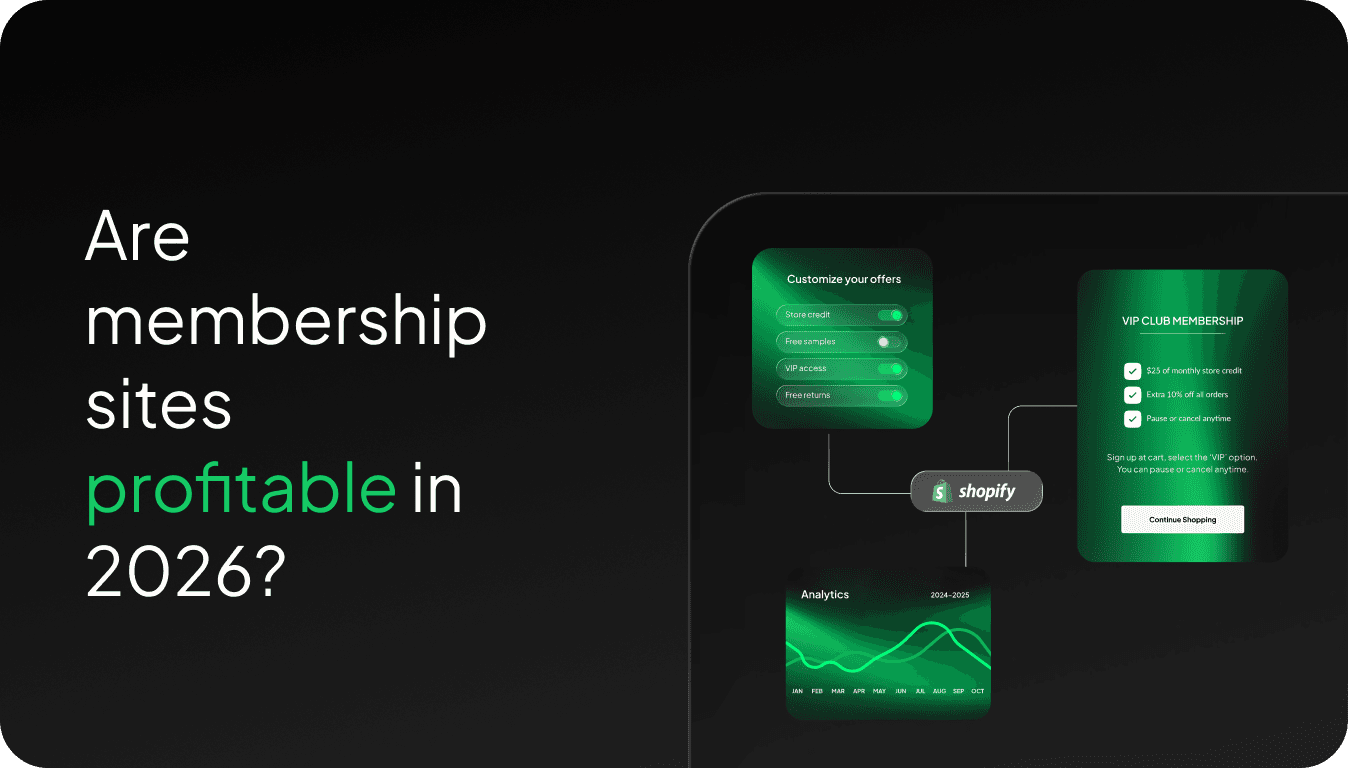
The real numbers behind membership revenue: what 200+ brands actually earn and why 73% see positive ROI within 6 months.
The short answer? Yes, membership sites can be extremely profitable. But the long answer reveals why most fail and a few succeed spectacularly.
After analyzing 200+ membership programs across beauty, lifestyle, and luxury brands, the data tells a clear story. The profitable ones share specific characteristics that the struggling ones miss entirely.
73% Hit Profitability Within 6 Months (But Only With This Model)
Traditional membership sites face a brutal reality: content creation costs scale linearly while revenue grows slowly. You need writers, video producers, community managers, and platform hosting. The math rarely works.
Product-based membership flips this dynamic completely.
Take Pair Eyewear's membership program. Instead of paying for content, customers pay monthly and receive store credit to spend on glasses. No content creation. No community management. Just commerce with a membership layer.
Result: 157% higher lifetime value for members versus non-members, with 29% of total revenue coming from membership.
The key difference? Product memberships monetize existing inventory instead of creating new assets. Your cost structure stays flat while membership revenue compounds.
The $2.8M Case Study That Changed Everything
Madam Glam launched their VIP membership using store credit as the primary benefit. Members pay monthly, receive equal or greater credit back, plus percentage discounts and early access.
Within 18 months: $2.8 million in membership revenue.
This wasn't luck. Store credit creates a psychological ownership effect that content memberships can't match. When someone has $25 sitting in their account, it feels like their money waiting to be spent. They come back.
Points programs average 15% redemption rates according to Forrester's loyalty research. Store credit memberships see 70%+ redemption rates across brands on Subscribfy's platform.
The math is simple. Higher redemption equals more repeat purchases. More repeat purchases equals higher lifetime value. Higher lifetime value equals a profitable membership.
Why 67% of Membership Sites Fail (And How to Avoid It)
As McKinsey notes, recurring revenue is one of the most powerful tools a business can build. But only when the underlying model is sound. Most membership sites fail for three specific reasons.
Wrong pricing model. They charge based on content consumption instead of value delivery. A $29/month membership that provides $39 in store credit plus discounts is an immediate win for the customer. A $29/month membership for "exclusive content" is a harder sell.
No retention infrastructure. They launch membership but don't track the metrics that matter: churn rate by cohort, lifetime value progression, credit redemption behavior, or cancellation drivers. You can't optimize what you don't measure.
Treating membership as a discount program. Successful memberships feel like exclusive clubs, not coupon books. The best programs combine financial benefits (store credit) with status benefits (early access, member pricing) and experiential benefits (free samples, exclusive sales).
The 115% LTV Boost That Drives Real Profit
Across brands using Subscribfy's membership platform, the average member lifetime value increases 115% compared to one-time purchasers after 14 months.
But here's what matters more: the average discount rate per member is actually lower than for non-members.
This seems counterintuitive until you understand the psychology. Members receive store credit instead of percentage discounts. Credit feels like money they own. Discounts feel like savings they earned. The first drives repeat purchases. The second drives bargain hunting.
Riversol saw this exact pattern after launching their membership. Members spend more per order and purchase more frequently, but require fewer promotional discounts to convert. The result: higher revenue per customer and better margins.
The Checkout Conversion Secret
Here's the most surprising profitability driver: membership opt-in rates at checkout.
Dossier achieves 45%+ opt-in rates by positioning membership alongside the purchase decision. Nearly half of all first-time customers immediately upgrade to VIP status.
Compare this to post-purchase membership offers, which typically see 8 to 12% conversion rates according to Shopify's retention research.
The difference? Timing and psychology. At checkout, customers are already in buying mode and evaluating value. Post-purchase, they're in consumption mode and questioning spend.
Tres Colori demonstrates this perfectly. Their jewelry membership achieves 49% opt-in rates at checkout and drives 48% of total revenue. For a category where traditional subscriptions make zero sense (you don't auto-ship necklaces monthly), membership thrives by focusing on choice and credit.
Platform Economics: Why Infrastructure Matters
Most membership sites use general-purpose platforms not designed for commerce integration. The result: clunky experiences, data silos, and operational complexity that kills profitability.
Ecommerce membership platforms integrate directly with your existing store infrastructure. Customer data flows seamlessly. Inventory management stays unified. Billing happens through established payment processing.
The operational efficiency difference is significant. Instead of managing multiple systems, you enhance one system. Instead of reconciling data across platforms, everything lives in Shopify.
The Loyalty Integration That Multiplies Results
The most profitable membership sites don't choose between loyalty and paid membership. They run both.
Loyalty programs reward every customer for engaging. Paid membership rewards your best customers with premium benefits. Together, they create a complete retention ecosystem.
Loyalty programs handle breadth. Memberships handle depth. The combination drives both acquisition (through points earning) and retention (through membership benefits).
Brands running both see higher member retention rates and better overall customer lifetime value compared to membership-only or loyalty-only programs.
The 2026 Profitability Formula
Profitable membership sites in 2026 follow a specific formula: store credit value greater than or equal to the membership fee, plus meaningful additional benefits, plus seamless checkout integration, plus retention optimization, plus a loyalty program foundation.
This isn't theory. It's the exact model that drove Adore Me to $300M in revenue and a $400M acquisition by Victoria's Secret, where membership infrastructure represented 30% of deal value despite being only 5% of revenue.
The profitability question isn't whether membership sites can make money. It's whether you're building the right type of membership with the right infrastructure and the right strategic focus.
Most membership sites treat recurring revenue as the goal. The profitable ones understand that recurring revenue is the result. The goal is creating so much value that customers can't imagine shopping without membership benefits.
When you nail that value equation, profitability becomes inevitable.
Ready to build a profitable membership program? Subscribfy provides the complete infrastructure and strategic guidance to replicate the models that actually work, with monthly optimization reviews to ensure your membership drives real profit from day one.

Book a meeting with our sales team now!
Create predictable revenue from the customers you already have.